


The Daevanion system is one of the core endgame progression mechanics in Aion 2 Global, offering permanent stat boosts and extra skill levels to refine a class’s combat performance. Unlike the updated Korean server Daevanion boards, the 2026 Global version retains the Season 1 board layout with smaller node pools and adjusted attribute values, making dedicated server-specific builds essential. For Templars—the game’s primary tank and frontline damage support class—a optimized Daevanion setup balances sustained defense, stable aggro retention, and consistent offensive output. This guide fully explains the Aion 2 Daevanion system, covers all valid ways to earn Daevanion Points, and breaks down the meta 300-point Templar Daevanion build node by node for both PvE and basic PvP scenarios.
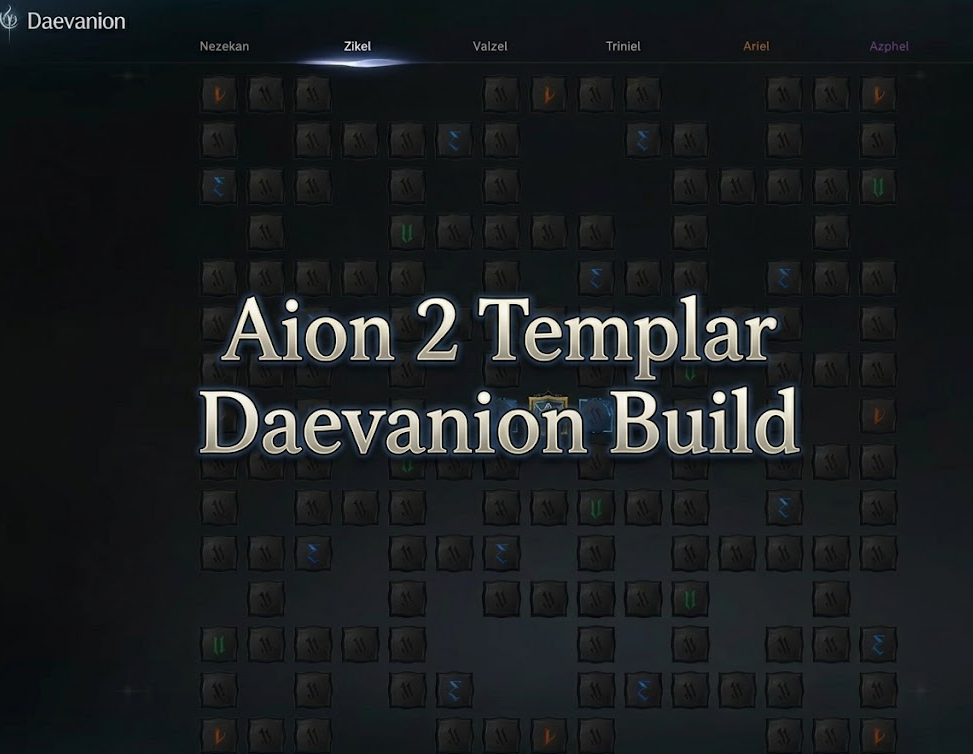
Aion 2 Templar Daevanion Guide
Daevanion Boards are a permanent character progression system in Aion 2 that enhances base stats and upgrades active and passive skill levels. The Global server features five unlockable boards that activate at specific character levels:Nezekan (Lv.12), Zikel (Lv.20), Vaizel (Lv.30), Triniel (Lv.40), and Azphel (Lv.45). The first four boards share a universal Daevanion Point pool, while the level 45 Azphel board is a PvP-exclusive tree that uses independent Daevanion Crystals.
All classes follow the same board layout structure on Global servers; only skill-specific nodes vary by class. Players can only unlock nodes adjacent to already activated ones, creating a fixed progression route for each board. Daevanion nodes are divided into four core types with distinct functions and point costs, forming the foundation of all builds:
Grey Nodes: Low-cost basic stat nodes that cost 1 point each, providing flat boosts to attack, defense, HP, MP, critical resistance, and other fundamental attributes.
Green Nodes (Passive Skills): Cost 2 points per node, used to upgrade the rank of character passive skills, improving sustained combat and defensive capabilities.
Blue Nodes (Active Skills): Cost 3 points per node, the primary way to enhance core active combat skills, directly boosting damage and skill effectiveness.
Orange Core Nodes: The most valuable nodes on each board, costing 4 points each. They deliver powerful percentage-based attribute bonuses, including combat speed, damage boost, and damage tolerance, and are indispensable for endgame builds.
A key Global server distinction: Season 1 core nodes offer roughly half the attribute values of the updated Korean server boards, so Korean meta builds are not applicable for Global players. Additionally, the Global Daevanion system has limited node slots, eliminating pay-to-win dominance and making patient, targeted node progression the most efficient strategy for all players.
How to Get Daevanion Points in Aion 2?
Daevanion Points are the exclusive currency for unlocking and upgrading board nodes. Players can accumulate points steadily through in-game activities, with supplementary sources for faster progression. All farming methods applicable to the 2026 Global server are listed below in order of priority:
1. Level Up Rewards & Faction Side Quests
Players earn 4 Daevanion Points per level from Lv.12 onwards. Completing faction-specific green side quests also grants consistent point rewards. This is the most passive and reliable source of points, contributing the majority of a player’s base point total by Lv.45 (approximately 300 base points).
2. Faction Sealed Dungeons
Clearing Sealed Dungeons belonging to your own faction rewards 2 Daevanion Crystals per completion. Enemy faction Sealed Dungeons provide no rewards, so players should prioritize daily runs of their faction’s dungeon rotations. This is the core daily farming method for incremental point gains.
3. Limited-Time Festival & Special Shops
The Shugo Festival and Nightmare Shop offer Daevanion Stones for purchase, with a maximum of 10 stones available per character per event cycle. These limited purchases add up to nearly 100 extra points, greatly accelerating early and mid-game board progression.
4. Ascension Rites Transmutation
Players can obtain Daevanion Fragments by completing Ascension Rites content, which can be transmuted into usable Daevanion Stones. The transmutation system features variable success rates: spending 10 fragments yields a 10% success chance, while 100 fragments guarantee a 100% success rate. Players can choose risky low-fragment crafting or safe full investment based on their resource reserves.
5. Abyss Content & PvP Shop Exchange
The second Abyss area features an Abyss Monolith that drops PvP-focused Daevanion Crystals. Players can also purchase up to 10 PvP Daevanion Stones per character from the Abyss Trade Shop. Note that these points are exclusively for unlocking the Lv.45 Azphel PvP board and have the lowest priority for PvE-focused Templars.
6. Player Trading
Some crafted Daevanion Stones are non-bound and can be listed on the player market for trade. This is an optional supplementary method for players with excess in-game currency, while account-bound stones can only be used by the player’s own characters.
Best Aion 2 Templar Daevanion Build (300 Global Points)
This 300-point Templar build is tailored specifically for Aion 2 Global Season 1 boards, optimized for mainstream PvE raid and dungeon gameplay while retaining basic PvP adaptability. The build follows a strict priority rule: core active skill nodes first, passive buffs second, orange core attributes third, and flat stat nodes last. It avoids wasted points on low-value skills and maximizes the Templar’s dual strengths of tank durability and consistent damage output.
Core Build Priority Rules
Before node allocation, follow these fixed priorities to ensure efficient point usage: Orange core nodes > Blue active skill nodes > Green passive skill nodes > Attack/critical bonus nodes > Defense/HP bonus nodes. Always unlock adjacent low-value nodes to reach high-value core nodes instead of skipping routes blindly.
Step-by-Step Node Allocation (Total: 297 Points)
Stage 1: Early Boards (Lv.12 & Lv.20) – Core Skill Foundation (55 Points)
Focus on maxing the Templar’s three signature core damage skills to Lv.12 via blue nodes on the Nezekan (Lv.12) and Zikel (Lv.20) boards. Prioritize Judgment, Vicious Strike, and Punishment. Judgment accounts for nearly half of the Templar’s total PvE damage, and raising these three skills unlocks the skill’s no-cooldown advanced spec at Lv.16, creating the build’s core damage foundation.
Stage 2: Early Core Attribute Buffs (29 Points)
Allocate 19 additional points on the Lv.12 Nezekan board to unlock orange combat speed core nodes—combat speed is critical for Templar attack rhythm and skill rotation smoothness. Spend 10 more points on the Lv.20 Zikel board’s damage boost orange nodes to amplify overall offensive output.
Stage 3: Skill Rotation Optimization (22 Points)
Invest 22 points on the Nezekan board to unlock cooldown reduction nodes. Lowered skill cooldowns let the Templar maintain continuous aggro on raid bosses and stack damage more consistently, solving the class’s core problem of intermittent damage gaps.
Stage 4: Mid-Game Skill Completion (49 Points)
After unlocking the Lv.30 Vaizel and Lv.40 Triniel boards, spend 35 points to upgrade the three core damage skills (Judgment, Vicious Strike, Punishment) to their maximum +4 bonus levels across all boards. Allocate 14 more points to raise Warding Strike and Shield Smite to Lv.12, enhancing shield-based defense and counterattack capabilities.
Stage 5: Key Passive Skill Enhancement (20 Points)
Invest 20 points in green passive nodes to max three high-value passives: Fury, Insulting Roar, and Impact Hit. Fury is the top-priority passive, as it boosts self and party PvE damage every time the Templar blocks an attack, providing excellent team utility and self-sustain. Skip low-value passives including Flash Rampage, Defiance, Warding Shield, Guarding Seal, and Survival Willpower to save points.
Stage 6: Late-Game Attribute Stacking (32 Points)
Spend 32 points on the Lv.40 Triniel board’s multi-hit chance core nodes. This attribute greatly improves the Templar’s burst damage potential and makes consistent damage output more stable in high-difficulty dungeons.
Stage 7: Remaining Point Allocation (90 Points)
Use the final 90 leftover points to unlock adjacent flat stat nodes along the core progression route. Prioritize attack and critical hit bonus nodes first to further boost damage, with no wasted points on redundant low-utility stats.
Full Board Point Breakdown
Nezekan (Lv.12): 81 points (full combat speed, cooldown reduction, and core skill nodes + all orange corners)
Zikel (Lv.20): 77 points (full damage boost corners + key passive and active skill nodes)
Vaizel (Lv.30): 49 points (pure core skill upgrades, no redundant corner nodes)
Triniel (Lv.40): 90 points (full multi-hit chance corners + supplementary stat nodes)