

Season 13 launches alongside the Lord of Hatred expansion on April 28, and it brings the most sweeping changes Diablo 4 has seen since its original release. With a complete skill tree overhaul for every class, two brand-new classes joining the roster, reworked itemization, the Horadric Cube, a Talisman and Charm system, and a massively expanded endgame that stretches to Torment 12, the build meta is about to shift in a big way. Our Diablo 4 LoH Season 13 Tier List ranks all eight classes for Season 13 and covers the top builds to consider for each one.

Diablo 4 Season 13 Class & Build Tier List (Lord of Hatred)
Blizzard has described the Lord of Hatred expansion as "Diablo 4 2.0," and the scope of changes supports that claim. Every class is receiving a complete skill tree rework, all passive nodes have been removed, skills can now receive up to 12 points of investment (up from 5), and each skill branches into three upgrade paths that include two sets of passive modifiers and one central path containing dramatic skill variants. These variants can completely change how an ability functions, alter its element, and even swap its gameplay tags, which determines how the skill interacts with the rest of your build. Beyond skill trees, the expansion introduces the Horadric Cube for crafting, a Talisman and Charm system with set bonuses, comprehensive loot filters, and a new endgame stretching to Torment 12. The level cap rises from 60 to 70 for all players, and every legendary aspect, unique item, and mythic item is being reformulated to match the new systems. Two new classes, Warlock and Paladin, bring the total roster to eight, while the original five classes are also receiving overhauls to their unique class mechanics to bring them in line with the more impactful designs of newer classes. All of these changes are going to reshape the class and build meta from the ground up, so here is how every class stacks up heading into Season 13.
1. Warlock (S Tier)
The Warlock is the headline class of the Lord of Hatred expansion, and every indication points to it being the strongest class at Season 13 launch. This is a pattern Blizzard has followed before — Spiritborn was dominant at the Vessel of Hatred launch, and the Warlock appears to be following the same trajectory. Community members who have played the class at preview events describe "impressive build diversity," and early reactions from the player base already flag it as likely to be overtuned. The Warlock's skill tree was built entirely under the new expansion framework, meaning it benefits fully from the variant system, the tag-swapping mechanic, and the deeper upgrade paths. Its class mechanic: demonology, allows summoning, transformation, and direct combat all within a single class identity. One of its ultimates, Rampage, can be transformed from a summon skill into a demon transformation mobility attack, completely changing its tags and interactions. This level of flexibility within a single class is unprecedented in D4, and it gives the Warlock access to more viable build archetypes than any other class at launch.
Best Warlock Builds for Season 13:
Demon Summoner / Demonology (S Tier) - The Warlock's summoning toolkit is the deepest in the game. Variants allow summons to follow you, change elements, and interact with the full demonology tag system. This is expected to be the go-to starter build because summon builds traditionally require less gear investment to function.
Hellfire Caster (S Tier) - Ranged fire-based builds using the Warlock's hellfire abilities. The variant system allows dramatic changes to how fire skills behave, and the class has strong synergies between its fire damage and demon-buffing mechanics.
Demon Transformation / Melee Warlock (A Tier) - The Rampage variant that transforms you into a demon opens a full melee playstyle. This is the most unique option — a caster class that can go full melee through skill variants. Gear requirements will likely be higher than the summoner or caster paths.
Hybrid Summoner-Caster (A Tier) - Combining demon summons with direct damage spells. The expanded skill point budget (12 per skill, level 70 cap) makes hybrid approaches much more feasible than they were under the old tree structure.
2. Spiritborn (S Tier)
The Spiritborn has been the dominant class since the Vessel of Hatred expansion, and nothing in the Lord of Hatred patch notes suggests it is being brought down to earth. It receives the same skill tree overhaul as every other class, which means its already-strong toolkit now gets access to more variant options, deeper upgrade paths, and the new 12-point skill investment system. The Spiritborn's unique class mechanic was already one of the most build-defining systems in the game, it was built from the start with the kind of deep customization that the older classes are only now receiving. Community sentiment heading into Season 13 is mixed: players appreciate the class's power but note that "so many cool skills we don't really use since they either are overshadowed by other skills or don't fit in the meta builds." The skill tree rework could open up some of those underused abilities. Even if the Warlock steals the spotlight at launch, the Spiritborn's proven endgame performance and existing gear ecosystem keep it firmly in S tier.
Best Spiritborn Builds for Season 13:
Eagle Spiritborn (S Tier) - Has been one of the top pit-pushing builds across multiple seasons. The skill tree rework may shift exactly which skills are used, but Eagle-focused builds are expected to remain at the top of the Spiritborn hierarchy.
Jaguar Spiritborn (A Tier) - Strong damage output with a faster, more aggressive playstyle. Benefits from the expanded skill point budget to invest more deeply into both damage and mobility skills.
Centipede Spiritborn (A Tier) - Poison-focused builds that have been competitive in previous seasons. New skill variants could add frost or shadow options to this archetype, depending on what the reworked tree offers.
Gorilla Spiritborn (B+ Tier) - The tankiest option. Has struggled to match the damage output of Eagle and Jaguar builds in pit pushing but offers the safest gameplay for hardcore and group content.
3. Paladin (A Tier)
The Paladin returns to the Diablo franchise for the first time since Diablo 2, and it arrives with a full Lord of Hatred-era skill tree. Like the Warlock, the Paladin's entire kit was designed under the new variant system, which gives it an inherent advantage over reworked legacy classes. The Paladin's identity is built around flails, shields, auras, and holy damage, a proven archetype that Diablo 2 players know can dominate endgame content. Community hype for the Paladin is high, and early reactions from those who played it at preview events (via pre-purchase access) are positive. The reason it sits in A tier instead of S is simply uncertainty: we have less hands-on information about the Paladin than the Warlock, and new classes at expansion launch tend to have one that's clearly overtuned (likely Warlock) while the other needs a season or two to find its footing. That said, the Paladin's toolkit is deep, its aura system provides party utility that no other class offers, and its defensive options (shields, holy protection skills) could make it the premier hardcore class.
Best Paladin Builds for Season 13:
Holy Smite / Flail Paladin (A Tier) - The classic melee Paladin fantasy. Flail attacks combined with holy damage auras and shield-based defense. This is expected to be the most straightforward and reliable build path.
Aura Support Paladin (A Tier) - A party-focused build that maximizes aura effects for group play. Auras in D4's Paladin affect nearby allies, which gives this build a unique role that no other class can fill. Its solo performance will likely be lower, but in group content it could be invaluable.
Blessed Hammer / Caster Paladin (B+ Tier) - If Blessed Hammer returns in some form (it was iconic in D2), a ranged holy caster build could emerge. This depends entirely on what skill variants are available in the final tree.
Shield Bash / Tank Paladin (B Tier) - A defense-first build focused on blocking, damage reduction, and counterattacks. Likely excellent for hardcore play and group tanking but slower for solo farming.
4. Sorcerer (A Tier)
The Sorcerer is one of the biggest winners of the skill tree rework among the legacy classes. The Hydra example shown by Blizzard, where a fire Hydra can be transformed into a Frost Hydra that interacts with the Sorcerer's freeze mechanics, demonstrates exactly the kind of build-defining choice that was missing from the class. Crackling Energy has been a community complaint for being "stale," and the new variant system should allow lightning builds to diversify beyond their current narrow path. The Sorcerer's problem in recent seasons has been that it had only one or two builds capable of pushing high pits. With every skill now offering three to four variant options, the number of viable combinations should expand considerably. The Sorcerer also benefits from items and legendary aspects being reworked, many current aspects were designed around the old passive system and will be rebuilt to support the new skill variants. If the rework delivers on its promise, the Sorcerer could push into S tier mid-season as players discover strong combinations the developers didn't anticipate.
Best Sorcerer Builds for Season 13:
Frost Hydra / Freeze Sorcerer (A Tier) - The poster child of the skill tree rework. Frost Hydras that interact with freeze bonuses open a completely new build archetype for the class. Expect this to be one of the most popular day-one builds.
Fire Hydra / Burn Sorcerer (A Tier) - The traditional Hydra build with new upgrade paths for explosion triggers, faster attacks, and longer duration. Stronger scaling potential with the 12-point skill investment.
Lightning / Crackling Energy Sorcerer (B+ Tier) - Needs the variant system to deliver meaningful changes to how Crackling Energy works. If new variants add AoE improvements or tag changes, this could jump to A tier. If the variants are minor, it stays where it's been.
Blizzard / Cold Sorcerer (B+ Tier) - A consistent performer that should benefit from the freeze mechanic synergies if Frost Hydra and other cold skills can be combined in new ways.
5. Necromancer (A Tier)
The Necromancer is receiving what might be the most dramatic structural change of any class in the expansion. Summons have moved out of the Book of the Dead and into the skill tree, meaning they now have the same upgrade paths, side modifications, and variant options as every other skill. This is a fundamental redesign. The Book of the Dead will be completely rebuilt into something new — the developers haven't revealed what it becomes, but the expectation is that it will follow the model of newer class mechanics (Spiritborn, Warlock, Paladin) and focus on deeper build customization rather than simple stat bonuses and sacrifice toggles. The potential here is enormous: imagine choosing between a Shadow Golem, a Blood Golem, and a Bone Golem directly through skill variants, then layering on Book of the Dead bonuses that buff your entire army. A full massive summon army build could emerge. However, the reason the Necromancer sits in B tier is risk. A rework this large could easily ship with balance issues, undertuned numbers, or combinations that look great on paper but don't scale in Torment 12. Until players can test the new Book of the Dead and the full summon variant tree, the Necromancer is a high-ceiling, uncertain-floor class.
Best Necromancer Builds for Season 13:
Full Summoner / Army Necromancer (A Tier if it works) - The dream build. Every summon type in the skill tree, upgraded with variants, buffed by the new Book of the Dead. If the numbers support it, this will be one of the most satisfying builds in the game. If they don't, it could be a Torment 4 build that hits a wall in higher content.
Blood Necromancer (B+ Tier) - Blood skills have been strong in multiple seasons. The variant system should add new options, maybe a Blood Nova that heals, or Blood Lance that applies vulnerability through a tag change. A solid bet for a reliable build.
Bone Necromancer (B+ Tier) - Bone Spear and Bone Spirit builds benefit from the 12-point skill investment. Bone builds tend to be straightforward and scale well with gear, which makes them a safe starter choice.
Shadow / Blight Necromancer (B Tier) - Shadow damage builds have traditionally been the weakest Necromancer archetype. The variant system could change that if shadow skills get meaningful tag changes, but this remains the riskiest path.
6. Druid (B Tier)
The Druid has been described by content creators as "probably going to be a dark horse in how cool it's actually going to be in the expansion," and that assessment feels right. The form selection change is massive: instead of each skill being locked to one form, players will be able to choose between werewolf, werebear, and potentially human for most abilities. Maul, a bear-only basic skill, can now be used in werewolf form. This opens up build combinations that were previously impossible — a full werewolf build that uses bear damage skills, or a caster Druid that stays in human form for everything. The Spirit Boons are almost certainly being reworked to support this new form selection system, moving from simple passive stat bonuses to something closer to the newer class mechanics. The Druid's ceiling in Season 13 could be very high. But it sits in B tier because form selection is the kind of system that can create confusion and unintended interactions at launch. Pulverize Druid has been a community staple, and while it will still work, the real question is what new builds emerge from the form freedom. That answer won't be clear until players get their hands on the final tree.
Best Druid Builds for Season 13:
Pulverize Werebear (B+ Tier) - The proven Druid build. Pulverize has been strong across multiple seasons, and the 12-point investment plus new upgrade variants should only make it better. The safest choice for Druid players.
Werewolf Tornado (B+ Tier) - If tornado skills can be used in werewolf form with full form bonuses, this creates a fast, mobile AoE build that could be very strong for farming. Depends heavily on how form selection interacts with skill tags.
Storm Caster / Human Druid (B Tier) - A caster-focused build that stays in human form. Lightning Storm and other nature spells with the new variant system could produce a viable ranged playstyle. This has been the weakest Druid archetype historically, but the skill tree rework could change that.
Hybrid Form Shifter (B Tier) - The build that tries to use the form selection system to its fullest, combining werewolf mobility with werebear damage in a single rotation. High skill ceiling, likely harder to gear and optimize than focused builds.
7. Rogue (B Tier)
The Rogue receives the same skill tree overhaul as every other class, and the variant system should give it more options than it currently has. But among all eight classes heading into Season 13, the Rogue has received the least attention in developer previews, community discussion, and pre-expansion reveals. No specific Rogue changes have been showcased in the way that Hydra variants were shown for the Sorcerer or form selection was discussed for the Druid. The Rogue's unique class mechanic, specializations (Combo Points, Inner Sight, Preparation), has been functional but not particularly exciting compared to newer class mechanics. Whether it receives the same level of rework as the Druid's Spirit Boons or the Necromancer's Book of the Dead is unknown. The Rogue has historically been capable of pushing high pits with specific builds (particularly Twisting Blades and Rapid Fire), and those builds will still exist in some form. But without any clear buffs, showcased improvements, or community hype heading into the expansion, the Rogue is positioned as a class that could surprise people but is more likely to sit in the middle of the pack until mid-season balance patches arrive.
Best Rogue Builds for Season 13:
Twisting Blades Rogue (B Tier) - The Rogue's most consistent build across multiple seasons. Benefits from the 12-point skill investment and will gain new variant options. A reliable choice that should work at launch.
Rapid Fire Rogue (B Tier) - A ranged option that has been competitive in recent seasons. New skill variants could add elemental changes (frost arrows, poison shots) that open up new synergies.
Shadow / Death Trap Rogue (C+ Tier) - Trap and shadow builds have been niche but functional. The variant system could add interesting trap modifications, but this archetype has historically been outclassed by Twisting Blades.
Poison Rogue (C Tier) - Poison builds exist but have struggled with endgame scaling. Needs specific variant and itemization support to become competitive.
8. Barbarian (C Tier)
The Barbarian finds itself in a familiar position heading into a new season: powerful in fantasy, underwhelming in practice compared to other classes. The skill tree rework applies to the Barbarian just as it does to everyone else, and the variant system could open up interesting options — imagine Whirlwind variants that change its element, or a Leap that transforms into a sustained AoE. But no specific Barbarian changes have been previewed or discussed by developers in the way that other classes have received attention. The Barbarian's unique class mechanic — the Arsenal system — allows equipping four weapons at once, but it has always been more of a gear management system than a build-defining mechanic. If it receives a rework on the level of the Druid's Spirit Boons or the Necromancer's Book of the Dead, the Barbarian could jump tiers. If it stays largely the same while other classes get dramatically more interesting, the Barbarian will continue to lag behind. The class has loyal fans and its melee fantasy is satisfying, but in a season where two new classes launch with fully modern skill trees and three legacy classes are getting marquee reworks, the Barbarian risks being the class that benefits least from the expansion.
Best Barbarian Builds for Season 13:
Whirlwind Barbarian (B Tier) - The signature Barbarian build. Benefits from the 12-point skill investment and should gain new variants. Whirlwind has been a reliable farmer in every season and that won't change.
Hammer of the Ancients (HotA) Barbarian (B Tier) - A big-hit melee build that scales well with gear. New variant options could add elemental damage types or AoE modifications.
Upheaval Barbarian (C+ Tier) - A ranged-ish option for Barbarian players who want something different. Has been functional but not competitive at the highest pit levels.
Rend / Bleed Barbarian (C Tier) - Bleed builds have been the weakest Barbarian archetype. The variant system could add new damage-over-time interactions, but this needs substantial support to become viable at endgame.
How do the Diablo 4 Lord of Hatred Systems Affect Every Class Equally?
Several changes in Lord of Hatred affect all eight classes regardless of which one you pick.
Level 70 and 10 Additional Skill Points
Every player goes from a level 60 cap to level 70, which means 10 more skill points to distribute. Combined with the 12-point-per-skill investment cap, this gives every build significantly more room to invest deeply in core abilities while still picking up utility or secondary skills. Builds that felt "point-starved" under the old system will have much more flexibility.
Torment 12 and the Extended Endgame
Torment difficulty now goes up to 12, which creates a much longer power progression curve. This means that the gap between good builds and great builds will matter more — a build that could clear Torment 4 comfortably might struggle at Torment 8 or 10. Classes and builds with strong scaling (multiplicative damage interactions, efficient AoE, survivability) will pull ahead at the highest tiers.
Loot Filters and Crafting Materials
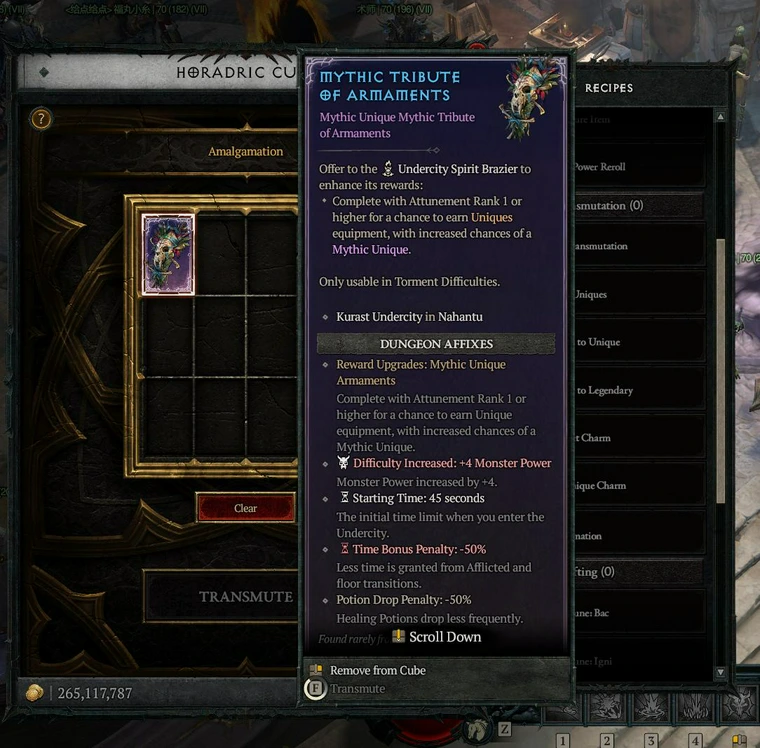
Loot filters arrive for all players, allowing you to customize which items appear on the ground. Blue and white items now drop in Torment content because they serve as crafting materials. The Horadric Cube (expansion-only) adds new crafting recipes. These changes benefit every class equally and should speed up the gearing process.
Reworked Legendaries, Uniques, and Mythics
Every legendary aspect, unique item, and mythic item is being reworked to match the new skill system. Items that previously gave points in passives (which no longer exist) will be redesigned. Items that duplicated effects now available through skill variants will either be removed or given new functionality. This means the tier list above could shift dramatically within the first week as players identify which reworked items synergize best with which skill variants.