

Flower breeding is one of the hardest things to do in New Horizons. It should be really simple — water flowers, go to the next day, and a new flower colour appears somewhere on your island. But when you get stuck into flower breeding, you may find yourself waiting forever for a blue rose to show up. There is so much misinformation online about the best methods to use and which layouts you need to get every single flower in the game.
Our ACNH Flower Breeding guide 2026 cuts through the confusion. We cover everything from basic growth stages and watering mechanics all the way through genetics, breeding pair combinations for all eight flower species, optimal garden layouts, and the cloning system that lets you duplicate your rarest hybrids without risk.
ACNH Flower Breeding Guide 2026
There are 8 different flower species in New Horizons that you can get in different colours: Windflowers, Lilies, Mums (Chrysanthemums), Tulips, Pansies, Hyacinths, Cosmos, and Roses. All of these have 3 basic colours which you can buy as seed bags from Nook's Cranny or Leif. It is from these seeded colours that you can breed all other colours available for each species of flower.
The process of breeding flowers is, at its core, quite simple. You need to have 2 colours of the same flower species next to each other in any orientation. When they are watered, there is a chance for you to receive a new flower the next day. But there is a lot more going on beneath the surface — from hidden genetics to layout efficiency to the cloning mechanic that was new to this entry in the series.
Below, we walk through each step in detail: how flowers grow, how watering works, how genetics determine your results, how to breed every hybrid in the game, and how to clone your rarest flowers once you have them.
1. Flower Growth
Flowers in Animal Crossing: New Horizons progress through four visible stages of development.
The Four Growth Stages
Stage 1: Sprouts
Stage 2: Stems
Stage 3: Buds
Stage 4: Blooms
When Can Flowers Breed?
Flowers can breed even when they are in the bud stage. Basically, as soon as you can see color it is worth watering them before the end of the day so that they will breed. You do not need to wait for a full bloom.
What Happens When You Pick or Trample Flowers?
Picked flowers return to Stage 2. Trampled flowers return to Stage 3. They will regrow on their own over time.
Where Flowers Can and Cannot Grow
Flowers will only grow on grass and the in-game dirt path. They actually do grow on the in-game sand path, but they will not grow on the sand on the beach. Flowers can breed even when they're in the bud stage, so basically as soon as you can see colour, it's worth watering them before the end of the day so that they'll breed.
2. Watering
Watering is the single most important daily action in flower breeding. Without it, nothing happens.
How To Water Flowers
In order for your flowers to breed or clone, you need to water them, which is as simple as pressing A whilst you are holding a watering can next to a flower. When you do this, you will see some droplets appear on the flower which eventually turn into sparkles. This is the sign that your flowers have been watered and are good to go for breeding.
Rain and Snow Replace Watering
The only time where you will not need to water your flowers is when there is rain or snow on your island because this will water all of your flowers at once.
Base Reproduction Chance
A watered Stage 3 or Stage 4 flower has a 5% chance to produce a new flower the next day. That may sound low, but there are several ways to boost it.
The Visitor Watering Bonus
You can invite friends to your island and they can water your flowers as well. This gives you a bonus which boosts the chances of you getting new flowers from your breeding pairs. You only need one person to come over to boost the chances of this happening, but if you have 5 friends come over to your island and water your flowers, this gives you the highest chance you can get to have new hybrid flowers.
Visitors from other islands can water your flowers to help you boost production chance up to 80%.
When your friends water your flowers, you will see the sparkles change on the flowers to become brighter and larger for every visitor who waters your flowers, so you will know when you have the highest chance to get new flowers.
Real-World Comparison: Self-Watered vs. 5 Visitors
In testing, a garden watered by the player alone produced around 12 new flowers in a day. The same garden after 5 visitors watered produced 42 new flowers — almost every pair that could breed did breed. It is definitely worth it if you can find five people that can come water when you are really focused on flower breeding.
The Bad Luck Bonus
If a flower fails to reproduce multiple times, it gets a bonus production chance. A hidden water counter tracks this. The flower gains 5% additional production chance for every time it fails after the third try. Remember that it will try every day if it has been watered.
Types of Watering Cans
Flimsy Watering Can: Waters one flower or space at a time.
Silver / Standard Watering Can: Made with a piece of iron; also includes store-bought variants like the outdoorsy watering can, the elephant watering can, and the colored ones.
Golden Watering Can: Lasts even longer and waters nine spaces at a time. You get the recipe from Isabelle when your island reaches five stars for the first time. This can is also required to produce gold roses.
The Beautiful Island Ordinance
Ordinances are unlocked when K.K. Slider has performed on your island for the first time. The Beautiful Island ordinance increases the chances you have for flowers to breed or clone. However, be warned that when you have this on, you will have more cleanup to do whilst you are flower breeding, particularly after a rainy day.
3. Genetics & Hybrids
To make things more complicated in flower breeding, Animal Crossing New Horizons also saw the addition of genes into flower breeding. If you have ever wondered why you are not getting the flowers you want, this may be part of the reason.
How Flower Genes Work
Each flower has 3 genes (4 for roses), which are a combination of hidden numbers that determine its colour. Every flower has a set of genes and these genes determine the colour of the flower. Be careful, there are multiple possible gene combinations for the same colour flowers. Two flowers that look identical can have completely different genetics and produce very different offspring.
Why Seed Bag Flowers Matter
For the flowers you get from seed bags, your native island flowers and the flowers you get from Nook Miles Ticket islands, they will all have the same base genetics. However, if you have had your native flowers for a while, there is a possibility they have bred and produced flowers which do not have the genetics you want, even if they look to be exactly the same colour.
It is always a safe bet to use seeded flowers unless you are moving previously grown hybrids to another step in a breeding chain. Flowers native to your island or from Mystery Islands are not guaranteed to have the genetic makeup necessary for the hybrids you might be trying to make.
In order to have the best chance to get every flower in the game, you will want to start your flower breeding from seed bags instead, so you prevent any bad genes making their way into the more complex hybrid flowers you need later.
Pro Tip
Avoid using breeding guides that only rely on color. Color alone does not tell you what genes a flower carries. You may get differing results if you use native or island hybrids.
4. Breeding
How Does Flower Breeding Work in ACNH?
Breeding means to produce offspring that is the result of two parent flowers of the same species. This offspring can either be the same color as the parents or a new colour altogether. The two flowers' (parents') genes will randomly mix together to form the genotype of a new flower (the offspring), which can be a new colour.
Touching Includes Diagonals
Flowers are considered to be touching when they are diagonal to each other. Two flowers anywhere within a shared 3×3 space will breed. They do not need to be directly side by side.
One Pair = One Offspring Per Day
When breeding, one pair of flowers (2 flowers) can produce a maximum of one offspring per day. Once a flower reproduces through breeding, that flower will not reproduce again for the day.
Flowers Prefer Breeding Over Cloning
Flowers will always try to breed before they try to clone. If there is a flower of the same species nearby who has not yet reproduced today, the flower that is reproducing will breed with that partner, and neither flower will reproduce again for the day.
Offspring Spawn Location
Flowers when producing a hybrid can spawn that offspring in a 1-tile radius around the parent flower, even in diagonals. Flowers also require at least 1 free adjacent space in order to spawn offspring. If all surrounding tiles are occupied, no new flower can appear.
The Locking Mechanic
A flower is locked when it has already bred for the day. A locked flower cannot be an eligible breeding partner for any other flower that day.
This poses problems in certain layouts (checkerboard, "X" patterns) as some flowers will clone instead of breeding. It is difficult to tell which offspring were the result of what process in these cases.
For example, if the tulips highlighted (white and red) decide to pair, the other 3 white tulips no longer have a valid partner, as the red tulip is locked. Any flower that does not have a partner because of either isolation or locking will only ever clone when it reproduces.
Random Pairing
The game chooses flowers in a random order to initiate reproduction, and then randomly chooses a partner from the flowers that are available. The flowers that do pair up are random and can be different every time.
How Does Layout Work in Flower Breeding?
Your layout determines three things: how many pairs can successfully breed each day, how often unwanted cloning happens, and how easily you can identify which pair produced a new offspring.
Why the Checkerboard / Cross Grid Is Inefficient
When you first load up the game on a new day, the game will decide which flowers will produce a new offspring. If a flower is chosen, the game next checks to see if there is another flower of the same species touching it that it can crossbreed with. If there is not, the offspring will be a clone. If there is, both parents will then be locked from potentially crossbreeding until the next day.
In a checkerboard layout, if any particular pair breeds, other flowers sharing those same partners may find themselves without an available mate. Those locked-out flowers will simply clone themselves. You could scale up the checkerboard pattern to decrease the chance of this happening, but since there are so many blank spaces in this layout it is really not efficient or compact at all. It works, but there are much better options.
Same-Colour Parents vs. Different-Colour Parents
The layout you should use depends on your goal. Are both parents the same colour (e.g., White × White for Purple)? Or are they two different colours (e.g., Red × White for Pink)? Each situation calls for different approaches, which we cover in the layout sections below.
Pair Up for Complex Hybrids
When you get into the more complicated levels of breeding, doing it in individual pairs is recommended. When there is one blue in the middle and four reds all around the edges, the blue is going to breed with one of the reds, which leaves the other three reds available to replicate. That makes it hard to tell which is which if both happen at the same time.
If you want to be 100% certain where a flower comes from, pair up your flowers one-to-one instead of doing the diagonal method. Remove any area for doubt as to where a flower came from.
How To Breed Each Flower & Best Layout For Each Flower Breeding
Below is a species-by-species guide covering every hybrid combination and the most space-efficient layout for each flower type. Always start from seed bag flowers unless otherwise noted.
Windflowers Breeding & Layout
Primary Colors (from seeds): Red, Orange, White
Hybrid Colors: Pink, Blue, Purple
Breeding Pairs:
| Parent 1 | Parent 2 | Offspring | Rate |
|---|---|---|---|
| Red (seed) | Orange (seed) | Pink | 100% |
| White (seed) | White (seed) | Blue | 25% |
| Blue (hybrid) | Red (seed) | Hybrid Red | 25% |
| Hybrid Red | Hybrid Red | Purple | 6% |
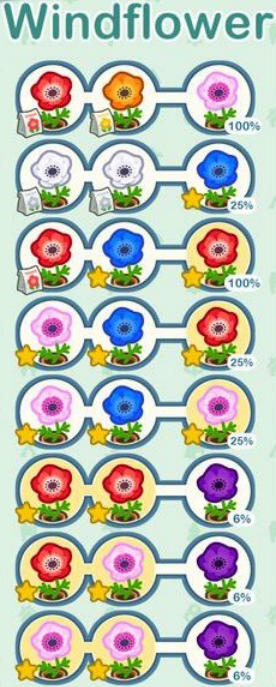
Step-by-Step Path to Purple Windflowers:
Breed Red (seed) × Orange (seed) → Pink
Breed White (seed) × White (seed) → Blue
Breed Blue (hybrid) × Red (seed) → Hybrid Red
Breed Hybrid Red × Hybrid Red → Purple
Important Notes for Windflowers:
When breeding blue and seeded red for hybrid reds, use individual pairs rather than a diagonal formation. If you place one blue in the middle surrounded by four reds, the blue will breed with one red, which leaves the other three reds available to replicate. There is no way of telling if a newly appeared red was a red replicating or if it was the hybrid red you wanted.
On day four of testing, pink wind flowers and blue wind flowers both appeared. By day 32, the first purple windflower finally showed up.
Most Space-Efficient Windflower Layout:
Use a compact arrangement with Red, Blue, and White seed flowers placed in a tight grid. The pairs should be: Red + Orange (for pink), White + White (for blue), and later Blue + Red (for hybrid red). Place two columns of flowers with enough empty spaces around them for offspring to spawn. Different species can fill gaps between windflower pairs since they cannot cross-breed.
Lilies Breeding & Layout
Primary Colors (from seeds): Red, Yellow, White
Hybrid Colors: Pink, Orange, Black
Breeding Pairs:
| Parent 1 | Parent 2 | Offspring | Rate |
|---|---|---|---|
| Red (seed) | White (seed) | Pink | 50% |
| Red (seed) | Yellow (seed) | Orange | 50% |
| Red (seed) | Red (seed) | Black | 25% |
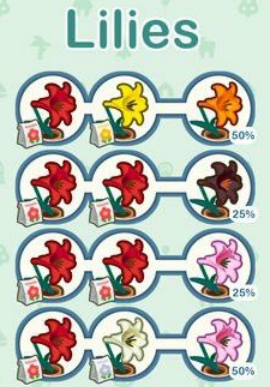
Why Lilies Are Great for Beginners:
Lilies are one of the simpler species with only three hybrids. They are not impacted by genetics to the same level as roses. By starting with lilies, you can learn the basics of flower breeding and work up to something more complex which does involve breeding special hybrids.
In testing, a pink lily appeared on day one. An orange lily appeared on day four from the red and yellow pair. A black lily finally arrived on day 13.
Most Space-Efficient Lily Layout:
Place Red, Yellow, and White lilies in a compact grid pattern. Red seeds pull double duty — they can breed with whites for pink and with yellows for orange. Once you have pink and orange, replace the whites and yellows with more reds to breed for black. A simple 3×2 block with Red in the center column, Yellow on one side, and White on the other works well for the initial stage.
Mums (Chrysanthemums) Breeding & Layout
Primary Colors (from seeds): Red, Yellow, White
Hybrid Colors: Pink, Purple, Hybrid Yellow, Green
Breeding Pairs:
| Parent 1 | Parent 2 | Offspring | Rate |
|---|---|---|---|
| Red (seed) | White (seed) | Pink | 100% |
| White (seed) | White (seed) | Purple | 25% |
| Red (seed) | Yellow (seed) | Hybrid Yellow | 100% |
| Hybrid Yellow | Hybrid Yellow | Green or Purple | 6% / 25% |
| Purple (from Hybrid Yellow) | Purple (from Hybrid Yellow) | Green | 25% |
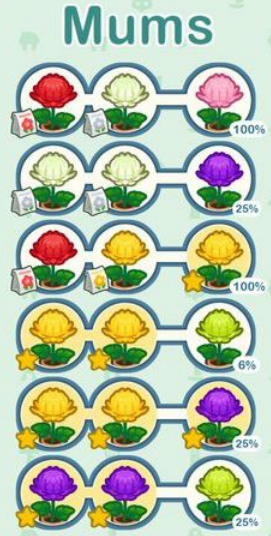
The Green Mum Path - A Multi-Stage Process:
Getting green mums requires patience and multiple stages.
Breed Red (seed) × Yellow (seed) → Hybrid Yellow
Breed Hybrid Yellow × Hybrid Yellow → Green (6% chance) or Purple (25% chance)
If you get purples from the hybrid yellows, breed those purples together → Green (25% chance)
Why Keeping Purples Separate Matters:
Purples bred from White × White mums will NOT produce green mums. Only purples that descend from the hybrid yellow line carry the right genetics. Keep them apart from purples made by other methods.
This is where it gets really important that you are cleaning out between each day, because a regular yellow that pops up does not have the same properties as a hybrid yellow. Make sure you remove any non-hybrid yellows immediately.
In testing, hybrid yellows appeared on day three. The first purple mum from hybrid yellows appeared on day eight. But the green mum did not arrive until day 36, and it came from the purples bred from hybrid yellows.
Most Space-Efficient Mum Layout:
Use a compact grid with Red + White (for pink), White + White (for purple), and Red + Yellow (for hybrid yellow) all in the same patch. Different mum pairs can share adjacent rows as long as you leave spawn space. Once you have hybrid yellows, dedicate a separate section just for those. Keep at least two spaces between hybrid yellow pairs and white-bred purple pairs so you never confuse the two types of purple.
Tulips Breeding Layout
Primary Colors (from seeds): Red, Yellow, White
Hybrid Colors: Pink, Orange, Black, Purple
Breeding Pairs:
| Parent 1 | Parent 2 | Offspring | Rate |
|---|---|---|---|
| Red (seed) | Yellow (seed) | Orange | 50% |
| Red (seed) | White (seed) | Pink | 50% |
| Red (seed) | Red (seed) | Black | 25% |
| Orange (hybrid) | Orange (hybrid) | Purple | 12% |
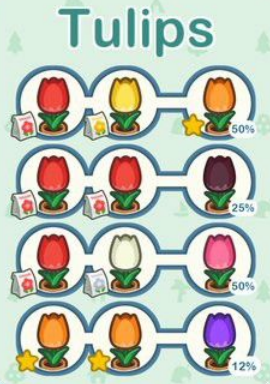
Step-by-Step Path to Purple Tulips:
Breed Red (seed) × Yellow (seed) → Orange
Let oranges clone until you have several
Breed Orange × Orange → Purple
In testing, a black tulip appeared on day seven, the first pink tulip on day eight, and an orange shortly after. The purple tulip did not arrive until day 32.
Most Space-Efficient Tulip Layout:
Set up Red + Yellow and Red + White in a combined grid, with Red + Red in a nearby section for black tulips. Once you have enough oranges, move them to their own 2×2 block or paired layout to breed for purple. Since purple tulips have only a 12% chance from orange pairs, having multiple orange pairs running simultaneously helps a great deal.
Pansies Breeding & Layout
Primary Colors (from seeds): Red, Yellow, White
Hybrid Colors: Orange, Blue, Hybrid Red, Purple
Breeding Pairs:
| Parent 1 | Parent 2 | Offspring | Rate |
|---|---|---|---|
| Red (seed) | Yellow (seed) | Orange | 100% |
| White (seed) | White (seed) | Blue | 25% |
| Blue (hybrid) | Red (seed) | Hybrid Red | 25% |
| Hybrid Red | Hybrid Red | Purple | 6% |
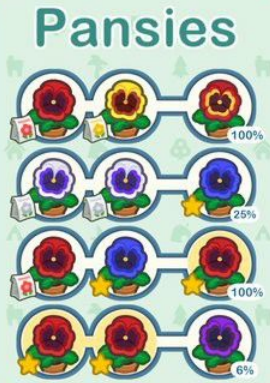
Step-by-Step Path to Purple Pansies:
Breed Red (seed) × Yellow (seed) → Orange
Breed White (seed) × White (seed) → Blue
Breed Blue (hybrid) × Red (seed) → Hybrid Red
Breed Hybrid Red × Hybrid Red → Purple
The Same Caution as Windflowers:
Similarly to windflowers, when breeding blue with seeded reds for hybrid reds, switch to individual pairs. If a regular red clone appears nearby, there is no way of telling if it was a red replicating or if it was the hybrid red. It is much easier just to trash unexpected reds than to try and guess at their genetic makeup.
In testing, blue and orange pansies both appeared on day three. Purple pansies finally arrived on day 23.
Most Space-Efficient Pansy Layout:
Arrange Red + Yellow pairs and White + White pairs in a compact grid. Later, set up Blue + Red pairs as isolated individual pairs with clear spacing between them. Once you have hybrid reds, group them in a 2×2 square for the best shot at purple. Because the purple pansy rate is only 6%, having multiple hybrid red pairs active at once speeds up the process considerably.
Hyacinths Breeding & Layout
Primary Colors (from seeds): Red, Yellow, White
Hybrid Colors: Pink, Orange, Blue, Purple
Breeding Pairs:
| Parent 1 | Parent 2 | Offspring | Rate |
|---|---|---|---|
| Red (seed) | White (seed) | Pink | 50% |
| Red (seed) | Yellow (seed) | Orange | 50% |
| White (seed) | White (seed) | Blue | 25% |
| Orange (hybrid) | Orange (hybrid) | Blue or Purple | 6% each |
| Blue (from Orange) | Blue (from Orange) | Purple | 25% |
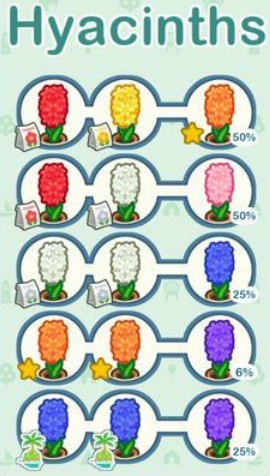
The Purple Hyacinth Path:
Orange hyacinths bred together can produce blue hyacinths. You can then use those blues — specifically the ones that came from oranges, NOT from White × White — to breed purple hyacinths. This method ended up being faster than waiting for purples directly from oranges in testing.
Make sure you are using the blues from the oranges and not the blues that came from breeding white hyacinths together. Those two types of blue look identical but carry different genes.
In testing, a pink hyacinth appeared on day five. The first blue came on day six, and an orange appeared shortly after. The first purple hyacinth arrived on day 30, and it came from the blues that came from the oranges.
Most Space-Efficient Hyacinth Layout:
Start with Red + White, Red + Yellow, and White + White in a combined grid. Once oranges are available, move them to their own 2×2 or paired layout. Keep blue hyacinths from oranges clearly separated from blue hyacinths bred from whites. Label them if possible using custom designs on mannequins.
Cosmos Breeding & Layout
Primary Colors (from seeds): Red, Yellow, White
Hybrid Colors: Pink, Orange, Black
Breeding Pairs:
| Parent 1 | Parent 2 | Offspring | Rate |
|---|---|---|---|
| Red (seed) | White (seed) | Pink | 100% |
| Red (seed) | Yellow (seed) | Orange | 100% |
| Orange (hybrid) | Orange (hybrid) | Black | 6% |
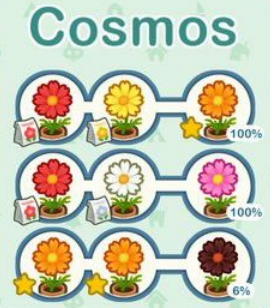
A Simple Species with One Tough Hybrid:
Cosmos are one of the simpler species alongside lilies with only three hybrid colors. Pink and orange come easily at 100% rates, but the black cosmos has only a 6% chance from orange pairs. In testing it took until day 60 to finally get a black cosmos, so have patience and breed as many orange pairs as space allows.
The reds are kind of pulling double duty — they can breed with either the yellows or the whites. You will never have a flower duplicate with two flowers at once, but it just has the option to breed with either partner.
Most Space-Efficient Cosmos Layout:
Place Red seeds in a central column with White on one side and Yellow on the other in a compact grid. Once you have several oranges, dedicate a full section to Orange × Orange pairs for black. Because it is just a percentage chance that you will get a hybrid, it is always better to have more pairs if you have the space to fill it up.
Roses Breeding & Layout (Standard Hybrids)
Primary Colors (from seeds): Red, Yellow, White
Standard Hybrid Colors: Pink, Orange, Purple, Black
Breeding Pairs:
| Parent 1 | Parent 2 | Offspring | Rate |
|---|---|---|---|
| Red (seed) | White (seed) | Pink | 50% |
| Red (seed) | Yellow (seed) | Orange | 50% |
| White (seed) | White (seed) | Purple | 25% |
| Red (seed) | Red (seed) | Black | 25% |
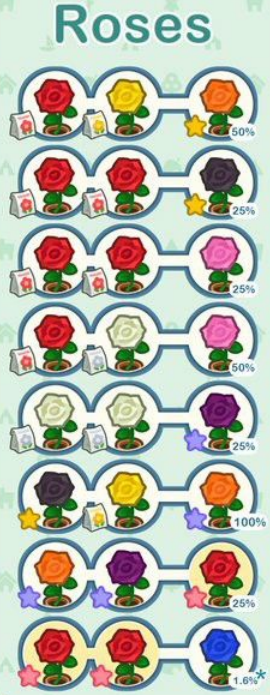
These four hybrid rose colours are straightforward and follow the same basic breeding logic as other species. In testing, a pink rose appeared on day four, purple roses on day five, the first orange on day nine, and a black rose on day 18.
Most Space-Efficient Rose Layout:
Roses have the most breeding pairs of any species due to the blue and gold rose paths. For the standard hybrids, arrange Red + White, Red + Yellow, White + White, and Red + Red in a combined compact grid. Each color pair should have spawn space nearby. Once you have enough purples and oranges, switch the white and yellow sections over to more reds for black rose production.
Blue Roses Breeding
Blue roses are the hardest flower to get in the game. If you tried to get a blue rose from just the seeded red roses, you'd find it impossible because they don't have the right genetics to produce a blue rose on their own. You need special hybrid red roses — although they look exactly the same as the seeded red rose, they have genes that have been created from breeding other hybrid flowers together.
There are two methods: a longer method with roughly 9.5 steps that gives you a higher percentage chance at the end, and a shorter 5-step method with a lower percentage chance per breeding cycle.
The Long Method (9.5 Steps — Higher Blue Rose Rate at the Final Stage)
Breed seed White × seed White → Purple
Breed Purple (Step 1) × seed Yellow → White (discard yellows)
Breed White (Step 2) × Purple (Step 1) → Purple (discard non-purples)
(Step 3.5 — Testing) Breed Purple (Step 3) × seed Yellow → if you get a Yellow, the purple is "good." If you only get whites after several attempts, the purple is bad — discard it. Keep at least two spaces between each test pair so you can tell which pair produced the offspring.
Breed Good Purple × Good Purple → Special White
Breed seed Red × seed Red → Black
Breed Special White (Step 5) × Black (Step 6) → Hybrid Red
Breed Hybrid Red (Step 7) × Special White (Step 5) → Orange
Breed Orange (Step 8) × Special White (Step 5) → Special Hybrid Red
Breed Special Hybrid Red × Special Hybrid Red → Blue Rose
This longer method is more steps, it is more work and more complicated, but once you get to the red stage you have a higher percentage of those reds creating a blue rose for you. In testing, the first blue rose from this method appeared on day 89.
Tips for the Long Method:
In Step 3.5, make sure you have at least two spaces between each test pair so you can tell which pair your new flowers come from.
Use mannequins with custom designs to number each step so you know where you are and do not get confused.
If you move a flower to the side to replicate, leave the label next to it so you know what step it came from.
Once you get confirmed good purples, put them in a 2×2 square so they can cross breed with any of the three next to them.
The Short Method (5 Steps — Lower Blue Rose Rate, But Faster Setup)
Breed seed White × seed White → Purple
Breed Purple (Step 1) × seed Red → Pink
Breed Pink (Step 2) × seed Yellow → Red (discard non-reds)
Duplicate Reds from Step 3.
Breed Red (Step 3) × Red (Step 3) → Blue Rose
This shorter method has a lower percentage rate of producing blues at the final stage. Hybrid red roses from this method only have a 50/50 chance of being able to produce blue roses. The ones that work will only have a 1.6% chance when watering to breed blue roses.
However, in testing this method actually produced a blue rose in a comparable timeframe (day 87) because Steps 1–3 are much faster, allowing many more red pairs to accumulate.
Recommendation: Run both methods at the same time if you have the space. One may pay off before the other depending on luck. It really only took a couple of days to get a blue once the right reds started breeding together from the long method, whereas the reds from the shorter method were going for quite a while before producing a blue.
Gold Roses Breeding
Gold roses can only be acquired through black roses which have been watered with a golden watering can, which you receive when you get a 5-star island. Surprisingly, these are actually easier to get than the blue rose.
How the Golden Flag Works:
When black roses are watered with a golden watering can, they get something called the golden flag. This is not visible to you as a player — it is just hidden in the code. Once your black rose is tagged in this way, there is a possibility that it will spawn a gold rose.
The Flag Only Applies to the Flower Directly in Front of You:
The flag is only applied to the flower which is directly in front of your character when you press A to water the flowers. So if you want to have as many chances as possible to get the gold rose, you will need to water every black rose individually until you have watered them all.
Save Your Golden Watering Can Durability:
Once a black rose has been given this golden flag, you do not need to water it again with a golden watering can until it produces a gold rose. Instead, you can save the durability on your gold watering can and use a normal one instead. Once a black rose has been watered with a golden watering can even once, it can go on to produce a gold rose at any time — even if it just gets rained on.
The Flag Resets After Producing:
Once the black rose has given you a gold rose, the flag is cleared from it and you will need to water it again with a golden watering can to tag it once more.
Gold Roses Cannot Clone:
Sadly, golden roses cannot clone, so if you want to have more of them, you will need to re-tag your black roses again to get more. Gold roses and Lily of the Valley are the only flowers in the game that cannot clone.
ACNH Best Flower Breeding Layouts (Patterns)
The layout you use depends on your goal, how much space you have, and how many visitors water your flowers. Here are the best layout patterns at different scales.
2×2 Flower Breeding Layouts
The smallest and most simple layout is just a 2×2 square of flowers. This means that if any particular pair of flowers is chosen to crossbreed, the other pair are still also available.
Best For: Same-colour parent breeding (e.g., White × White for Purple Mums, Red × Red for Black Roses).
Stacking Benefit: You can stack 2×2 squares of different species together to keep them compact. For example, breed red roses together to try and get blacks right next to a 2×2 of white chrysanthemums for purple. Since the chrysanthemums and the roses cannot cross breed with each other, it is completely safe.
Spawn Space: Leave at least one row of empty tiles around each 2×2 block so offspring have room to appear.
This layout is clone-resistant because every flower always has at least one same-species partner available, even if the other pair gets locked.
3×3 Flower Breeding Layouts (Grid Pattern)
If you have more space and your goal is to try and breed many more hybrids per day, try the grid pattern.
At first it looks like it is not efficient at all, but it is actually far better than the checkerboard since every flower is touching between two to six potential partners and there is a far lower chance of a flower cloning itself. This layout is simple, repeats infinitely to fill your space, and works well if you either water your flowers yourself or have help from visitors.
Best For: Large-scale same-colour breeding when you want maximum daily output.
Turtle Variation: If you want to increase efficiency a little more, you can offset every other grid hole by one space, creating the turtle pattern. It is less simple to create, and putting dirt down underneath the parents helps keep track of which ones you do not want to dig up. It has the potential to produce more offspring than the original grid pattern.
4×4 Flower Breeding Layouts (Super Turtle / Hex Hole)
For even larger gardens, two patterns stand out at this scale:
Super Turtle: Repeat the turtle pattern infinitely to create the super turtle, which works best for a large space with three or more visitors watering your flowers for you.
Hex Hole Pattern: If you plan on having one, two, or no visitors watering for you, you are better off using the hex hole pattern. It is a large version of the grid but with holes offset by one space every other row. This has less spawning space for new offspring than the super turtle, but more flowers are packed in. Since the spawn rates will be lower due to fewer visitors watering, it is slightly more efficient than a large version of the grid.
5×5 Flower Breeding Layouts - Why You Should Probably Skip It
Honestly, save yourself the time and ditch those 5×5 layouts — they are not worth it. Over the years the game has been out, countless guides have said "do this and you'll get these flowers every single time," and every time one of those guides was used, the results were either the wrong flowers or a confusing mess where it was impossible to tell which flowers were breeding and which hybrids needed to spawn in the spaces around them.
At the end of the day, the basic mechanic of flower breeding is that as long as you have two flowers of the same species next to each other, it really does not matter which format you use to get the flowers you want. There is nothing wrong with having a small flower breeding section on your island where you just breed or clone one or two pairs of flowers at the same time.
12×12 Flower Breeding Layout - Breed All Flowers at Once
For players who want every hybrid from every species running simultaneously in a single compact space, the 12×12 breed-all-flowers layout is an option.
How It Works:
A 12×12 grid is divided into 4 zones, each handling different species and breeding stages. Seed flowers, intermediate hybrids, and final hybrids all share the same plot in a carefully arranged pattern.

Total Seeds Required: 52
| Zone | Seeds |
|---|---|
| Zone 1 | Red Roses ×3, White Roses ×6, Yellow Roses ×3, Red Mums ×2, White Mums ×1, Yellow Mums ×1, Red Windflowers ×3, White Windflowers ×4 |
| Zone 2 | Orange Windflowers ×1, Red Cosmos ×2, White Cosmos ×1, Yellow Cosmos ×1, Red Tulips ×4, White Tulips ×1, Yellow Tulips ×1 |
| Zone 3 | Red Hyacinths ×2, White Hyacinths ×3, Yellow Hyacinths ×1 |
| Zone 4 | Red Pansies ×3, White Pansies ×4, Yellow Pansies ×1, Red Lilies ×3, Yellow Lilies ×1 |
Who This Layout Is For:
This layout is best for players who want to breed all species at once and are comfortable managing a dense garden. It requires daily maintenance to remove unwanted offspring and track which hybrids came from which pairs.
Trade-Offs:
The density means some pairs may lock each other out, and identifying the source of new flowers can be tricky. For simpler, more controlled breeding, individual species layouts or independent pairs are easier to manage.
Independent Pairs Layouts
For breeding flowers from two different colors (e.g., Red × White for Pink Chrysanthemums), the independent pairs layout offers the most control.
Plant your parents down and leave a blank space around them entirely for controlled breeding. If you are tight on space, you can mix other species in between the gaps of the independent pairs since they will not cross with each other.
Best For: Different-colour parent breeding, complex multi-step hybrids (blue rose steps), and any situation where you need to know exactly which pair produced an offspring.
Diamond Layout
The diamond layout is another option that has the same benefit as the 2×2 grid since if a pair of flowers produces an offspring, there is always a second pair available to do the same, no matter which original pair breeds.
If you overlap another diamond of a different species, you get a very compact plot that can produce four offspring with no chance of duplication, and all of the flowers can be watered in two swings of a watering can.
Both the diamond and the intertwined diamonds can be extended, but you risk converting your layout into the checkerboard pattern, which is typically ineffective.
General Flower Breeding Layout Tips
If you want to make cleanup a little bit easier, you can always fence off your flower breeding areas or use custom codes to prevent flowers from spreading from one area to another. Flowers will not spread into tiles that are covered with a code or are full.
Bushes work well too. If you want to fence off your area or use bushes to separate one breeding section from another, this might be the best option to help you keep flowers in the right places.
Use custom designs displayed on mannequins to label certain flowers or steps in a long process like the blue roses, so you do not forget what they are or what you need them for.
A trash can nearby is a must. It is a lot quicker to be able to discard flowers you do not need if you have one nearby.
Flower breeding does take up a lot of room, so it is easiest to do it when you have a lot of open space on your island. Keeping it confined to one area makes watering a lot easier each day and makes it quicker to see new growth.
5. Cloning
How Does Flower Cloning Work in ACNH?
Unlike past games, New Horizons added the option to clone flowers. Cloning means to produce an offspring with the same genotype of its parent by using only one flower. The clone is an exact copy, same genes, same colour, no mutation risk.
When a flower has been watered and there is no other flower of the same species around it that it can potentially breed with, the only option it has is to clone itself. So if you plant a yellow cosmos and water it, there is a chance that the next day you will get another yellow cosmos with identical genetics.
When Does Cloning Occur?
For cloning to happen, a reproducing flower must have no neighbours of the same species that have not reproduced for the day. This means the flower must either be:
Completely isolated from any flower of the same species within its 3×3 area, OR
Surrounded only by flowers of different species (different species cannot breed with each other, so the flower's only reproduction option is cloning)
Cloning With Different Species Nearby
Cloning can also happen when you have two flowers of different species next to each other. If you put a red hyacinth next to a yellow rose and you water them, they will not have the ability to breed, but you will get a chance of clones from both flowers. All flowers shown in such an arrangement are of different species, and as such they can only clone as they are not touching any flower of the same species.
Why Cloning Is So Valuable
Once you have a flower that has the right genetics, you do not need to worry about trying to breed more of that flower. Because cloning is a thing, all you need to do is leave the hybrid flower in a space on its own, water it, and you will get an exact copy of that flower which has the right genetics for you to use to breed the next level of flowers.
This is great for when you already have your desired flower and you want to make more of the same one without risking further gene mutation.
Cloning Is More Efficient Than Breeding for Duplicates
When you have a particular flower you want more of, cloning is better than breeding. One flower can clone into 1 flower, but a pair of flowers will still only be able to produce 1 offspring. So cloning gives you a 1:1 ratio per parent, while breeding gives you 1:2.
Move Clones Away Immediately
Once you have a duplicate, move that duplicate away because you do not want the duplicates to breed with each other. You just want them to continue cloning themselves. Make sure they are completely surrounded by open space so that they can duplicate safely.
Cloning Exceptions
The gold rose and Lily of the Valley are the only flowers that cannot clone.
How Does Layout Work in Flower Cloning?
The goal of a cloning layout is the opposite of a breeding layout. In breeding, you want same-species flowers touching. In cloning, you want to guarantee that no same-species flower touches another.
Isolation Is the Key Mechanic
For a flower to clone, it must not touch any other flower of the same species in a 3×3 space centered on the flower you are trying to clone. If there is even one same-species flower diagonally adjacent, the game will attempt to breed instead of clone, and you may get offspring with different genetics than the parent.
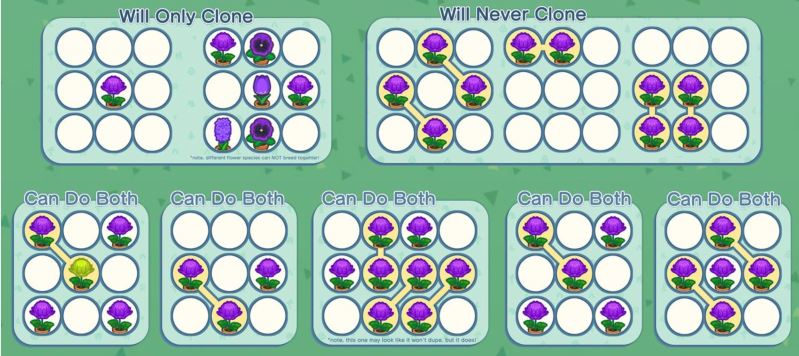
Putting flowers of the same species together will cause breeding, not cloning. This can mean you might have 2 pink mums together but they end up giving you a basic red mum. Putting flowers of the same species together will cause their genes to cross.
Why You Need Two Empty Columns Between Groups
Each flower needs an empty space to clone onto. If you are using visitor watering bonuses combined with stacked luck adjustments, you could have up to a 95% flower reproduction rate per day. You should expect to have enough space to allow all your flowers to clone. Two columns of empty space between planted columns handles this high reproduction rate.
Best Flower Hybrid Cloning Layouts (Patterns)
Single-Flower Isolation Grid
The most simple way to clone is by placing a grid similar to the independent pairs layout but with only one flower per spot. Each flower gets its own empty ring of tiles to produce a potential clone. This is the safest option - zero risk of accidental breeding.
You could do 1 flower with 8 empty spaces next to it in a 3×3 grid, but that is space-inefficient and hard to water. The layouts below improve on this.
Two-Wide Block of Mixed Species
Another option is by placing a two-wide block of different flowers that you want to duplicate. As long as no flower that is touching is of the same species, any flower that produces an offspring will always result in a clone.
For example, alternate cosmos, tulips, roses, and hyacinths in a tight 2-column strip. Every flower has neighbors, but none share a species, so every reproduction event produces a clone. This is more space-efficient than the single-flower grid.
The Numbered Column Layout
A popular community layout uses a repeating pattern where each number represents a different species:
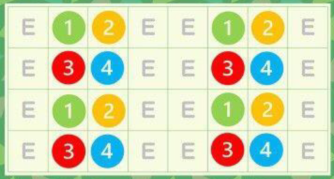
(E = empty space)
Each number represents a different species. It does not matter what color it is. It does not have to be a repeating pattern, but this will help your garden look more pretty and organized. Two columns also make it easy for your 3×2 watering can.
Customize this layout to your needs. Just make sure flowers of the same species are not touching — including diagonally.
An 82% cloning rate overnight has been reported with this style of layout and visitor watering bonuses active.
Cloning Layout Tips
When you are not sure if a certain layout promotes cloning by locking, draw circles denoting the pairs. Think of all the possibilities for how the game might pair flowers up.
Ideally all flowers would have found their intended partners, but the game can pair flowers in unexpected ways, resulting in unpaired flowers that clone instead of breed. Take this into consideration when designing layouts.
If a new clone appears next to your original, dig it up and move it to its own isolated spot before the next day. Otherwise, the original and the clone might breed instead of both cloning.
Custom designs on mannequins or clothing displays work well for labeling which clones belong to which breeding step, especially during complex multi-step processes like the blue rose path.